How Node.js Handles Multiple Requests with a Single Thread
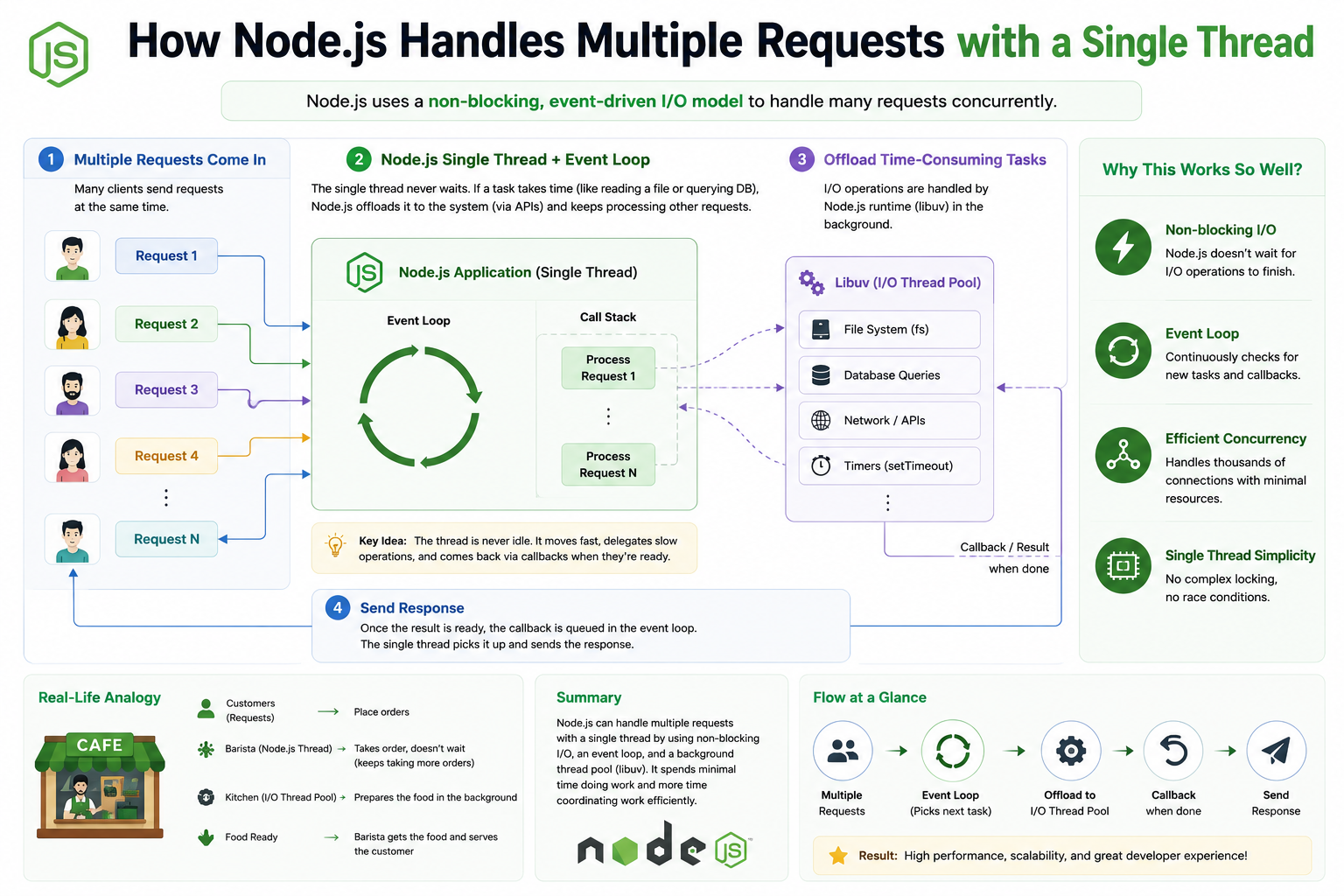
If you have ever heard that Node.js is single-threaded and wondered how it manages to handle thousands of simultaneous users without grinding to a halt, you are not alone. It sounds like a contradiction. One thread, many requests. How does that work?
The answer is not that Node.js found a way to do many things at once. The answer is that it found a way to almost never wait.
What Single-Threaded Actually Means
A thread is the smallest unit of execution in a program. It is a sequence of instructions that a processor works through one at a time. Most server environments handle concurrency by spinning up many threads, one per request or one per connection, and letting the operating system juggle them. More requests means more threads. More threads means more memory and more overhead managing them all.
Node.js takes a different approach. It runs your JavaScript code on a single thread. There is one call stack, one sequence of execution, and it processes one thing at a time.
This is not a limitation that was overlooked. It was a deliberate design decision rooted in a specific observation: most server-side work is not computationally heavy. It is waiting. Waiting for a database to respond. Waiting for a file to load from disk. Waiting for a network call to return. If your thread spends most of its time waiting, adding more threads does not make things faster. It just adds overhead.
Node.js was built around eliminating the wait.
The Chef Analogy
Imagine a kitchen with a single chef. This chef takes your order, starts your dish, and while it simmers on the stove, takes the next order, starts that dish, checks on something in the oven, plates a finished meal, takes another order.
The chef is not cooking everything simultaneously. There is still one pair of hands, one brain, one sequence of actions. But the chef is never standing still, staring at a pot waiting for water to boil. The moment a task requires waiting, they move on to something else and come back when it is ready.
That is Node.js. The chef is the single thread. The orders are incoming requests. The simmering pots and preheating ovens are I/O operations happening in the background. The chef stays busy by never blocking on a wait.
A kitchen full of chefs, where each chef handles exactly one order from start to finish and waits through every pause, would be the multi-threaded model. It works, but you need a lot of chefs and a very large kitchen.
Where the Event Loop Comes In
The event loop is the mechanism that makes this possible. It is a continuously running process at the heart of Node.js that checks one question on every cycle: is there something ready to be handled?
When a request arrives, Node.js starts processing it. If the processing requires something that takes time, like reading a file or querying a database, Node.js does not sit there waiting for it to finish. It registers a callback, meaning "when this is done, run this function," and immediately moves on to the next thing in the queue.
The event loop keeps cycling. It checks whether any previously delegated tasks have completed and returned a result. When one has, it picks up the associated callback and runs it. Then it moves on again.
This cycle is fast. The event loop itself never blocks. JavaScript code runs, completes quickly, and returns control to the loop. The loop then decides what to do next.
The key principle is that JavaScript code on the main thread should never block. Long-running computations, heavy processing, anything that would tie up the thread for a noticeable amount of time goes against the grain of how Node.js was designed to work.
Delegating Tasks to Background Workers
One question follows naturally from all of this: if Node.js is single-threaded, where does the actual I/O work happen? Who is reading the file while the event loop moves on?
The answer is that Node.js does not operate entirely alone. Underneath the JavaScript runtime sits a library called libuv, which manages a pool of background workers. When Node.js encounters an operation that would block, such as reading from disk or making a network call, it hands that operation off to libuv. The background workers handle the slow work using the operating system's own asynchronous capabilities.
Your JavaScript thread keeps running. When the background worker finishes its task, it signals the event loop. The event loop picks up the callback associated with that completed task and runs it on the main thread.
From your code's perspective, you handed off a task and got a result back later. The machinery in between is invisible. This is exactly why asynchronous programming, callbacks, promises, async/await, exists in Node.js. It is the natural interface for a system built around handing work off and picking up results when they arrive.
How Multiple Client Requests Are Actually Handled
Imagine three users hitting your server at almost the same moment. User A requests a page that involves a database query. User B requests a file from disk. User C requests something that can be answered immediately from memory.
Here is roughly what happens:
Node.js receives User A's request and begins processing it. When it hits the database query, it hands that off to a background worker and moves on.
Node.js receives User B's request. It hits the file read, hands that off to a background worker, and moves on.
Node.js receives User C's request. There is no I/O involved, so it processes and responds immediately.
A moment later, the database query for User A completes. The event loop picks up the callback, finishes processing User A's response, and sends it back.
Shortly after, the file read for User B completes. The same thing happens.
All three users received responses. The single thread handled all three requests by never blocking on any of them. It kept moving forward, delegating the slow parts, and circling back when they were ready.
Concurrency Without Parallelism
There is an important distinction buried in all of this. Node.js achieves concurrency but not parallelism.
Parallelism means multiple things are literally happening at the same time, on separate processors or cores, simultaneously. Parallelism requires multiple threads or processes and is what languages like Java or Go lean on heavily for performance.
Concurrency means multiple things are in progress at the same time, but not necessarily running simultaneously at the exact same instant. Node.js is concurrent. At any given moment, several requests may be partially processed, with parts of their work delegated to background operations. But only one piece of JavaScript is executing at any instant.
For most web servers, concurrency is what you actually need. Requests spend far more time waiting for databases and network calls than they spend executing code. Node.js is exceptionally well suited to this reality.
Where Node.js struggles is CPU-intensive work: image processing, video encoding, complex calculations. These tasks cannot be delegated to a background I/O worker. They need the thread, and they hold it. While one heavy computation runs, everything else waits. This is the genuine limitation of the single-threaded model, and it is why Node.js is a poor fit for computation-heavy applications without additional tooling.
Why Node.js Scales Well
Traditional multi-threaded servers consume memory and resources for every thread they spin up. Under heavy load, the cost of maintaining thousands of threads becomes significant. Thread management, context switching, synchronization between threads: these are real costs that add up.
Node.js handles thousands of simultaneous connections on a single thread with a very small and consistent memory footprint. There is no cost per connection in the way that thread-based models incur. The event loop handles connection management efficiently regardless of how many are open.
This makes Node.js particularly well suited to applications that maintain many open connections but keep each one relatively lightweight: real-time chat, live notifications, streaming data, APIs serving many clients. These are situations where the number of concurrent connections is high but the work per connection is mostly waiting for I/O.
The single-threaded model also has an underappreciated benefit for developers: no shared state between threads, no race conditions, no need for locks or mutexes. Writing concurrent code in multi-threaded environments requires careful management of shared resources. In Node.js, the single thread means you never have to worry about two pieces of code modifying the same data at the same instant.
Wrapping Up
Node.js handles multiple requests not by doing many things simultaneously but by never stopping to wait. The event loop keeps moving, delegating anything slow to background workers, and picking up results when they are ready. One thread, continuously busy, never blocked.
The chef does not stand at the stove watching water boil. They are already taking the next order.
This model has real constraints: CPU-intensive work exposes the limits of a single thread. But for the kind of work most web servers actually do, reading data, writing data, passing responses back and forth, Node.js turns the single-threaded model from a limitation into a strength.
You are all set!
written by theadroitdev(Shivam Verma) :)
X → https://x.com/theadroitdev
Github → https://github.com/TheAdroitDev
ChaiCode Repo → https://github.com/TheAdroitDev/ChaiCode-Cohort-2026


